What this article is for
Installers often size a 24V driver from the watts printed on the lamp or the strip, then find the supply running hotter than expected when every colour is full. That is a common constant-voltage RGBW PWM behaviour. It is how the load is specified, not a reason to treat the fitting as faulty or the driver as undersized.
This guide uses Hi-Line's 24V 6W MR16 RGBW PWM spotlight (HL-RGBWW-PWM-24V-6W) as the working example. The same rules apply to RGBW LED strip on a 5-wire PWM controller. For strip current per channel and common-anode wiring, see RGBW LED strip wattage and wiring.
What the labelled watts mean
On this module, 6W is the nominal total. Red, green, blue and warm white are four independent channels on a 5-wire constant-voltage PWM connection (VCC+, R-, G-, B-, W-). A mixed colour or a single channel sits well under that figure. All four at 100% is the maximum load.
Size the driver for all channels on, not for a typical scene. Full RGB plus full white is a test colour, not everyday use, but it is the figure that protects the supply when someone does turn everything up.
Why a meter can read a little over 6W
These lamps are constant-voltage PWM, not constant-current. Current is set by the resistors on each colour. As the aluminium body warms, LED forward voltage falls slightly, so current rises a little. A cold reading around 6W can move to about 6.5-7.5W once the module has been on. That is expected on this type of load.
The module will feel warm at full RGBW. It is a 6W-class lamp in a 50 mm body. Warm running is the dissipation doing its job. Measure at the 24V DC of the lamp, not on the mains side of the driver (that reading includes driver losses).
20% minimum, around 50% on site
20% spare capacity is the usual minimum on any constant-voltage LED installation: cable loss, warm running, and driver life. The same allowance is used for LED strip and other 24V loads. It is not particular to this lamp.
Around 50% spare is what we would use for this RGBW PWM load in a ceiling. Count each 6W lamp as about 9W. That keeps the driver cooler and leaves room for all-on scenes, voltage at the high end of 24V, and several fittings on one supply.
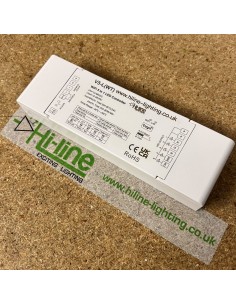
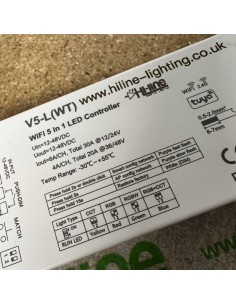
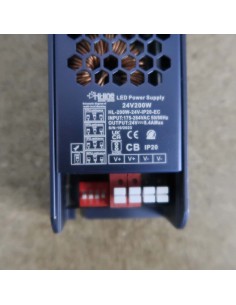
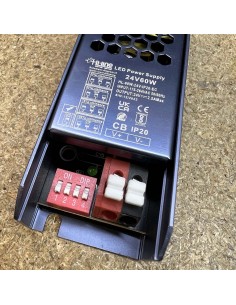
Use a non-dimmable 24V constant-voltage driver. Colour and brightness sit on a PWM RGBW controller. For this 5-wire load we usually specify HL-V5-L(WT), not a mains-dimmable PSU.
Worked example: the 6W MR16
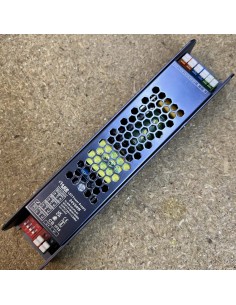
Indoor 24V IP20 drivers. A 60W driver is not a ten-lamp pack.
| Lamps |
Nominal |
Minimum (20%) |
Preferred on site (50%) |
Indoor 24V driver to use |
| 5 |
30W |
36W |
45W |
60W IP20 |
| 10 |
60W |
72W |
90W |
100W IP20 covers the 20% floor. On site we would use 150W IP20. |
| 20 |
120W |
144W |
180W |
150W IP20 is the 20% floor. Preferred: 200W IP20. |
The product page for the spotlight has the same driver-sizing note under Technical Specifications.
RGBW strip uses the same arithmetic
A 14.4W/m RGBW strip, 5 m, all channels on, is 72W nominal. Minimum driver about 86W (20%). Around 108W if you apply the same 50% ceiling allowance. Do not size from one colour only. Channel-by-channel watts and 5-wire current are in the RGBW strip wattage article.
Installer checklist
- Take the labelled watts as nominal, all channels on.
- Add at least 20% spare. For this PWM RGBW ceiling load, budget about 50% (9W per 6W lamp).
- Use a non-dimmable 24V driver plus a 5-wire RGBW PWM controller.
- Keep cable runs short enough that voltage drop does not shift colour between fittings. Longer runs belong on the constant-current professional modules, not this PWM spotlight.
- Allow the fitting to dissipate heat. A warm body at full RGBW is expected; a driver sitting at 100% of its rating is not the aim.
Disclaimer
Hi-Line Lighting supplies products only and does not provide on-site installation, technical consultancy, or a full lighting design service. This article is general guidance for typical 24V RGBW PWM driver sizing. All calculations, wiring, safety checks and regulatory compliance must be carried out and verified by a qualified installer. Incorrect design or installation can cause overheating, equipment damage, or fire.
If you do not have a lighting designer and need help on a larger or more complex project, contact us. We can put you in touch with trusted external partners.
Need help specifying a similar run?
Email [email protected] with the number of lamps or metres of RGBW strip, indoor or outdoor, and the controller you intend to use. If you receive an automated reply with a ticket number, keep it. If you do not receive that reply, please call to confirm the message arrived.