Introduction
A very common situation occurs during LED strip installations:
someone buys a modern LED-compatible wall dimmer, installs several metres of LED strip or multiple LED drivers, and suddenly the dimmer starts to struggle.
Typical symptoms include:
• flickering
• buzzing
• uneven brightness
• dimmer shutting down
• the driver not responding
• or the dimmer not accepting the full load at all
Many people then ask:
“My LED dimmer works perfectly with small loads. Why can’t it control a larger LED strip installation? Is there something I can add to make it work?”
The answer is yes — and the solution is much simpler than replacing the entire dimming system.
Why LED Dimmers Fail With Larger Installations
LED wall dimmers — even high-quality ones — are designed for low to medium loads. When connected directly to a large LED installation, several things happen:
-
LED drivers have high inrush current
They draw a very large instantaneous current when switching on. This overloads the dimmer immediately.
-
Multiple LED drivers in parallel multiply the stress
Two, three or more drivers connected to one dimmer can cause the dimmer to fail or behave unpredictably.
-
LED strips are often installed in long runs
An 8–10 metre installation with a single driver is already heavy.
Multiple sections, each with their own driver, make the load even bigger.
-
Smart LED dimmers are designed for small domestic loads
Usually limited to around 100W–150W total.
Once this limit is passed, the dimmer can no longer manage the load safely or reliably.
The Correct Solution: Extend the Dimmer Load Capacity
Instead of replacing the dimmer, the correct and safe solution is to insert a module that:
• takes the phase-cut dimming signal from the dimmer
• handles the heavy electrical load separately
• protects the dimmer from inrush current
• manages large LED drivers or several drivers at once
• provides stable dimming across the entire installation
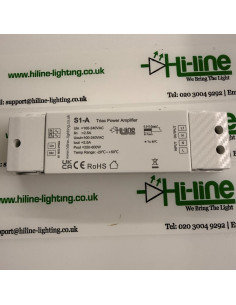
This device is known as a phase-cut dimming extension module.
It turns the dimmer into a control signal only, while the module performs the actual high-current switching.
How the Extension Module Works (Simple Explanation)
-
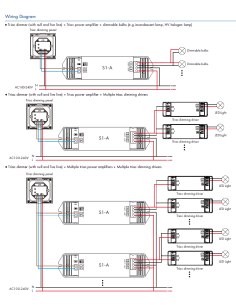
The wall dimmer sends a low-power control signal.
-
The extension module reads this signal.
-
The module outputs a high-power, phase-cut dimmed AC supply to the LED driver(s).
-
The dimmer never carries the load — the module does.
This means:
✓ the dimmer stays cool
✓ the dimmer no longer overloads
✓ the installer can connect large LED loads
✓ multiple LED drivers can be used together
✓ the dimming performance becomes stable and smooth
One dimmer can even control multiple extension modules for extremely large projects.
Real-World Example: Why This Matters
Consider an 8–9 metre LED strip installation in a bathroom, split into several areas such as:
• dropped ceiling
• shower niche
• vanity lighting
Depending on brightness, this may require:
• a 200 W dimmable driver (for COB 15 W/m)
or
• a 300 W dimmable driver (for SMD 28.8 W/m)
A wall dimmer cannot directly control a 200 W or 300 W LED driver — it simply is not designed for this load.
Even if the driver itself supports phase-cut dimming, the dimmer does not support the driver.
This is where the extension module becomes essential.
How the Extension Module Solves This
• It accepts both leading-edge and trailing-edge signals
• It outputs up to 600 W, ideal for UK installations
• It protects the dimmer from inrush currents
• It allows a dimmer to control large LED drivers smoothly
• It avoids flicker, uneven brightness and overload
For a driver of 200 W or 300 W, the module provides the required headroom and stability.
Why It Is Important for LED Strip Installations
LED strip projects often face additional challenges:
• voltage drop on longer cable runs
• uneven brightness in multi-zone runs
• waterproof IP68 strips needing careful sealing
• multiple mounting points at different distances from the driver
The extension module ensures that all LED drivers respond identically to the dimming signal, regardless of load or length.
This results in:
• clean dimming from 100% to low levels
• uniform brightness across the entire installation
• protection of the dimmer and the driver
• long-term reliability
Common Question Answered
“Can I still keep my existing dimmer?”
Yes.
You keep your dimmer exactly as it is.
You simply add the extension module between the dimmer and the LED driver.
This is the correct way to dim high-power LED installations using a standard wall dimmer.
Conclusion
If your wall dimmer is LED-compatible but cannot handle the size of your LED strip installation, the solution is not to replace the dimmer — it is to extend its load-handling capacity.
A phase-cut dimming extension module (600W) allows your dimmer to control:
• larger LED drivers
• multiple LED drivers in parallel
• long LED strip runs
• waterproof IP68 installations
• high-demand commercial projects
This is the professional method used by electricians to ensure stable, safe and long-term reliable dimming performance.
If you are planning a large LED strip installation and need guidance, the Hi-Line Lighting Support Team is always here to help.