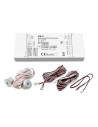
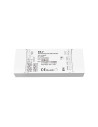
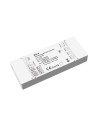
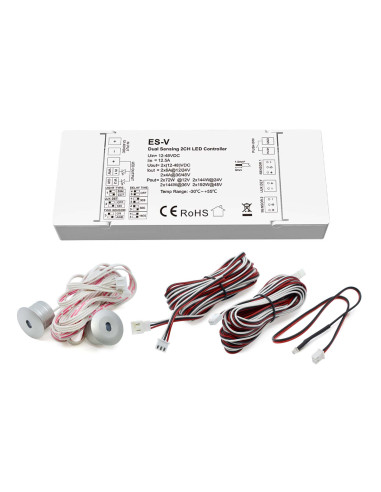
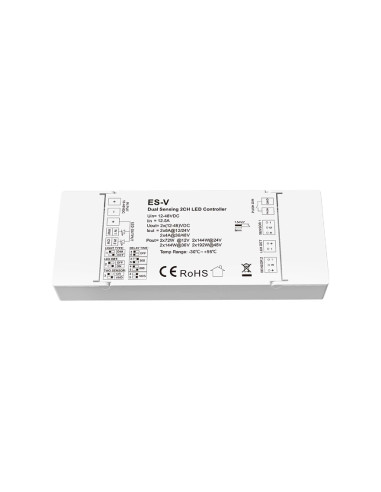
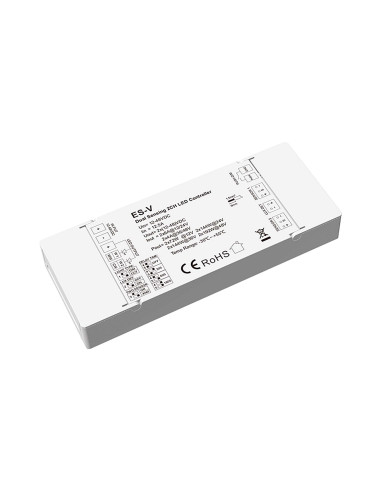
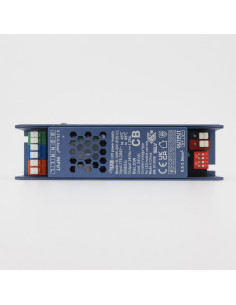
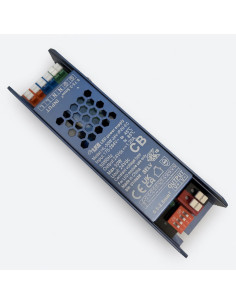
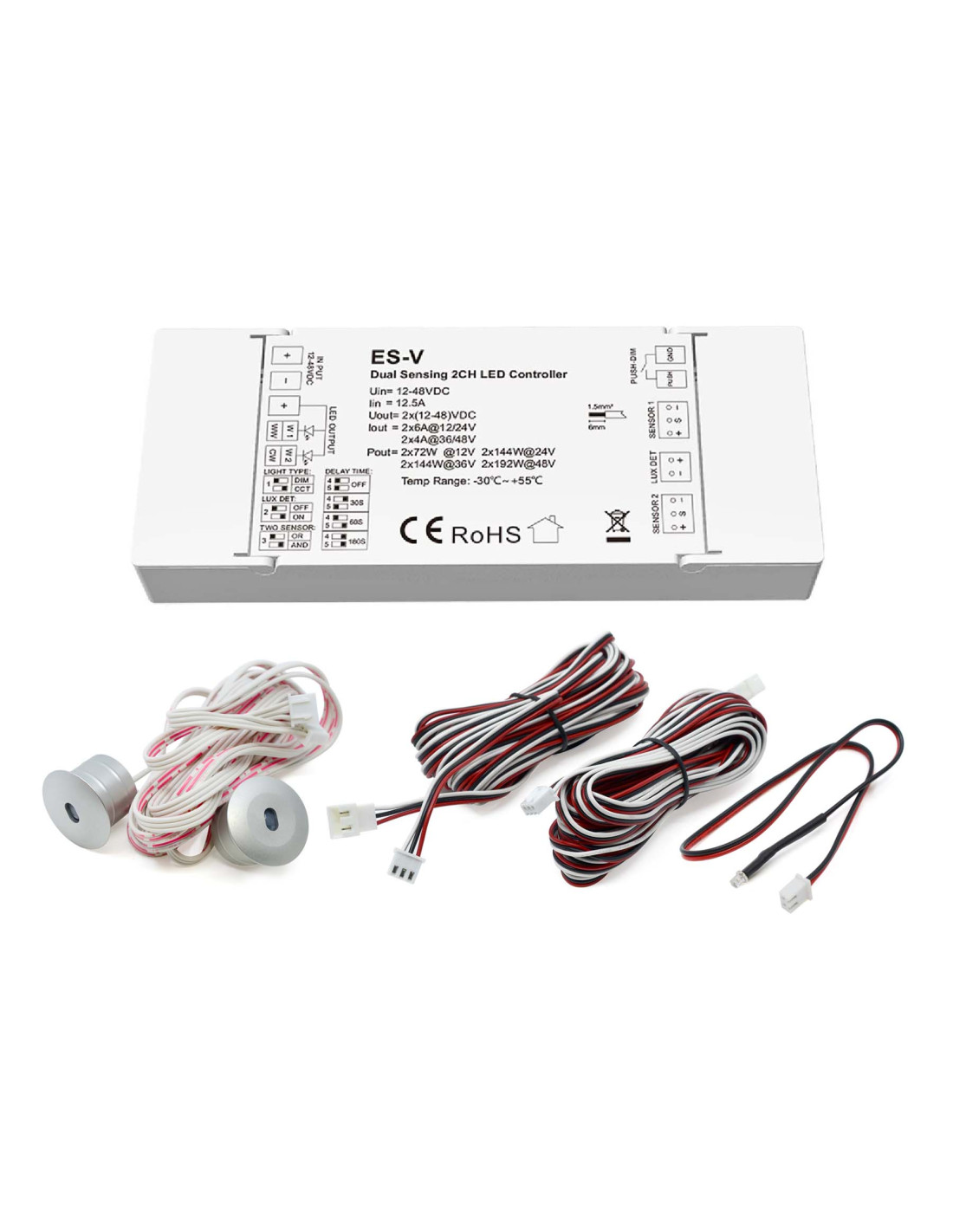
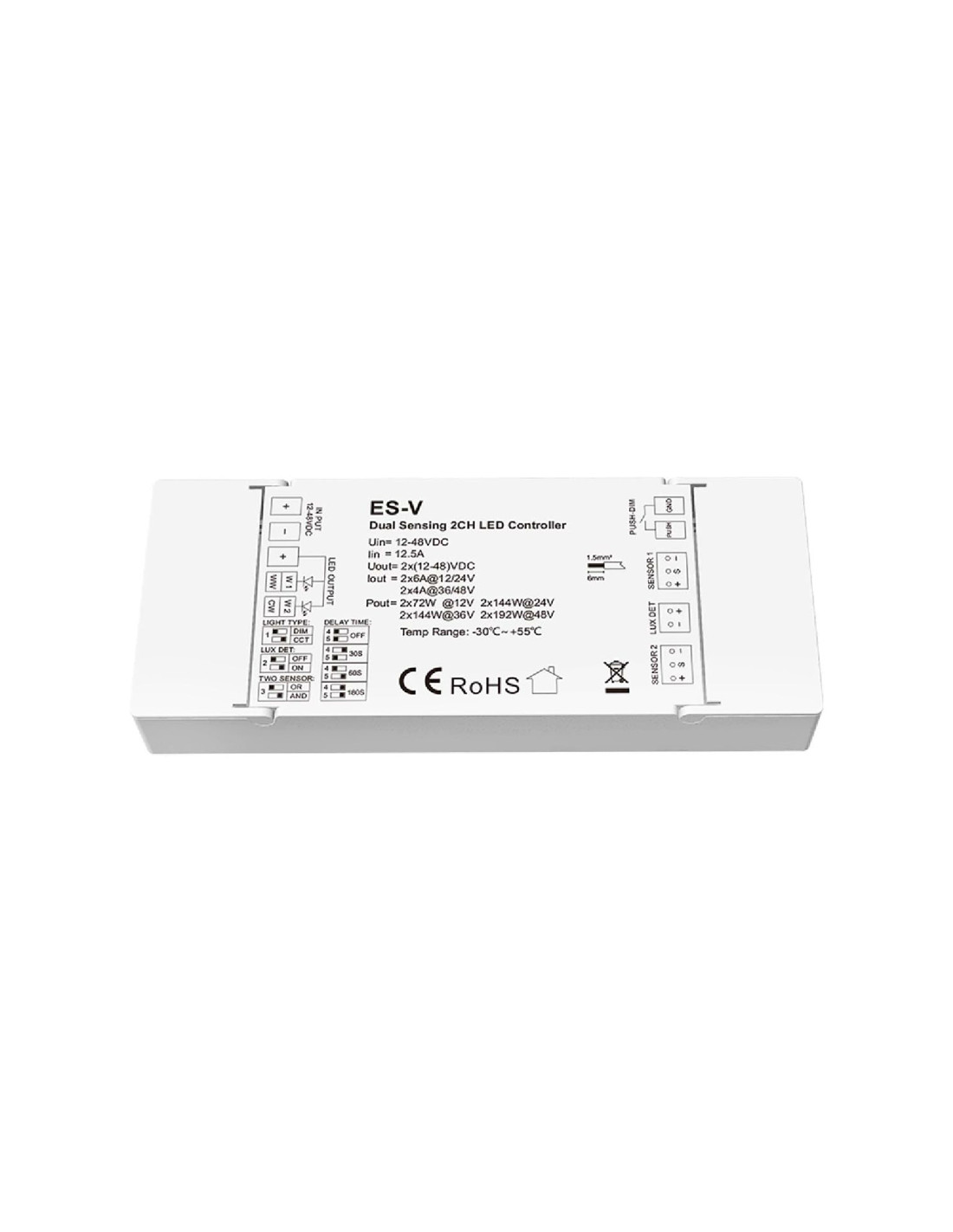
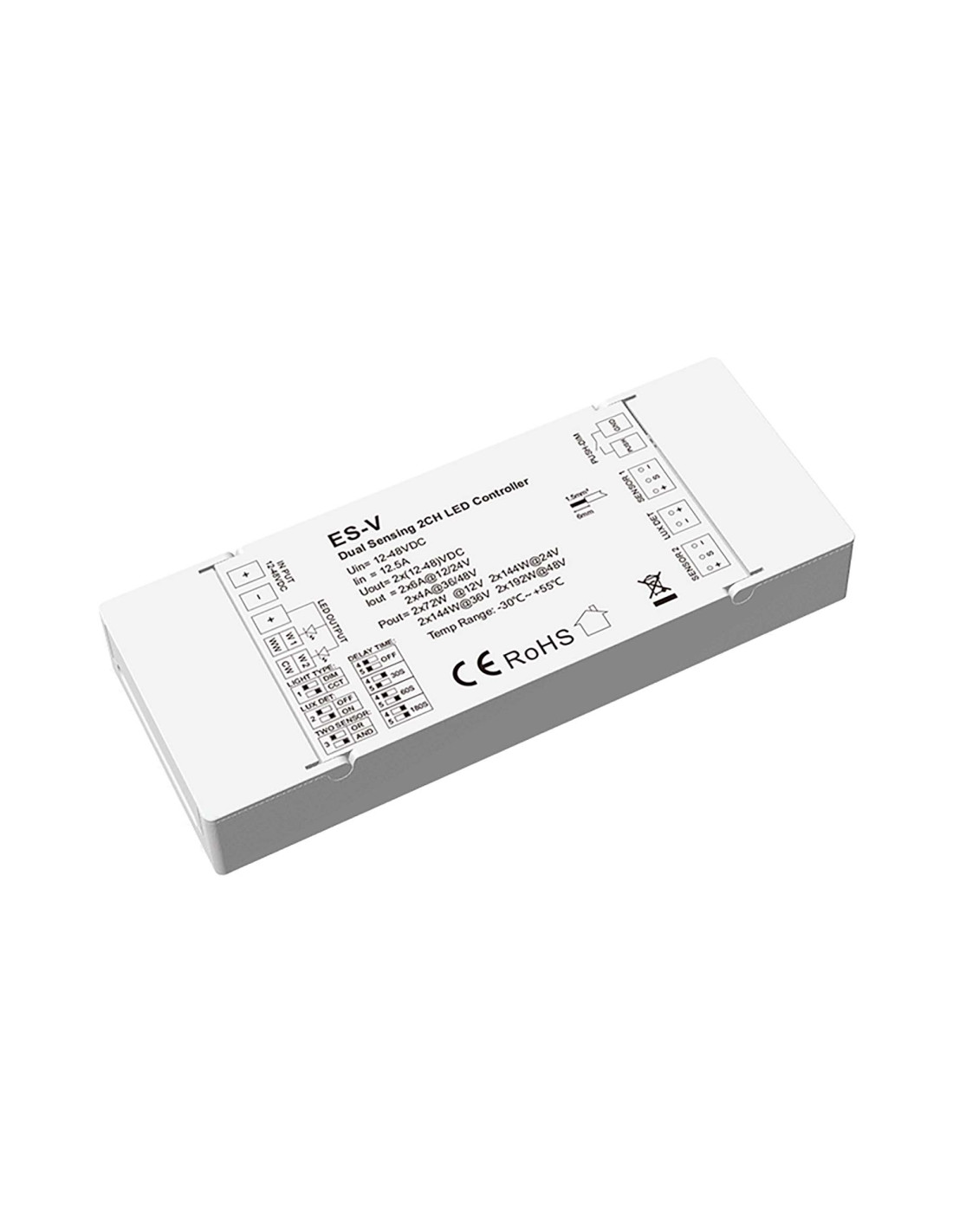
HL-ES-V is a two-channel constant-voltage controller for 12-48 V DC. One switch selects a single-colour strip or a 3-wire tunable-white strip. The same unit has two sensor sockets, a daylight socket and a push socket. The box contains the controller, two PIR heads on 1.2 m leads, one daylight sensor on a 30 cm lead, two 5 m PIR extension leads, and the manual. A power supply, an LED strip and a push switch are not included.
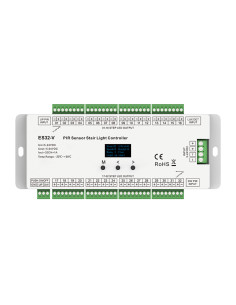
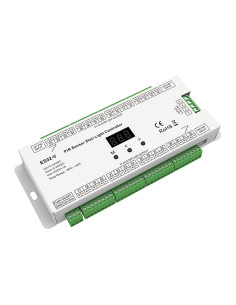
It is not an RGB, RGBW or pixel controller. It has no app, no Wi-Fi and no radio handset. It is not DALI, not DMX and not 0-10 V. The whole run comes on together and goes off together. For a staircase that must light one tread at a time, use HL-ES32-V.
Supply. Use a non-dimmable constant-voltage supply at the same voltage as the strip. Do not feed it from a mains dimmer. 12 V and 24 V are the voltages used on Hi-Line strips. 36 V and 48 V are within this controller when the strip and the supply are both that voltage. Do not mix two voltages on one controller.
Load. The input is 12.5 A. Each output is 6 A at 12 V or 24 V, and 4 A at 36 V or 48 V. That is 2 x 72 W at 12 V, 2 x 144 W at 24 V, 2 x 144 W at 36 V, and 2 x 192 W at 48 V. Add the wattage of the length that will be on at once, and choose the next driver size above that load. A short cabinet can use the 30 W driver. The related tunable-white reel is about 19.2 W/m, so five metres, all on, is about 96 W and the 100 W 24 V driver is the next size. One controller feeds one circuit.
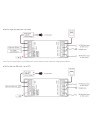
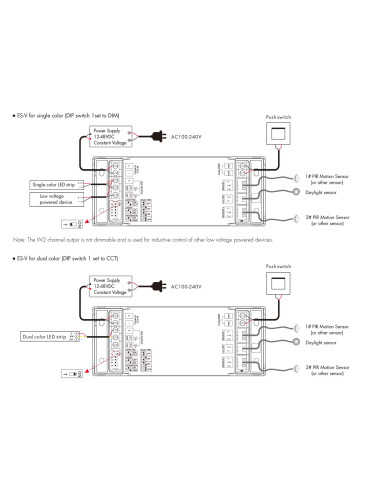
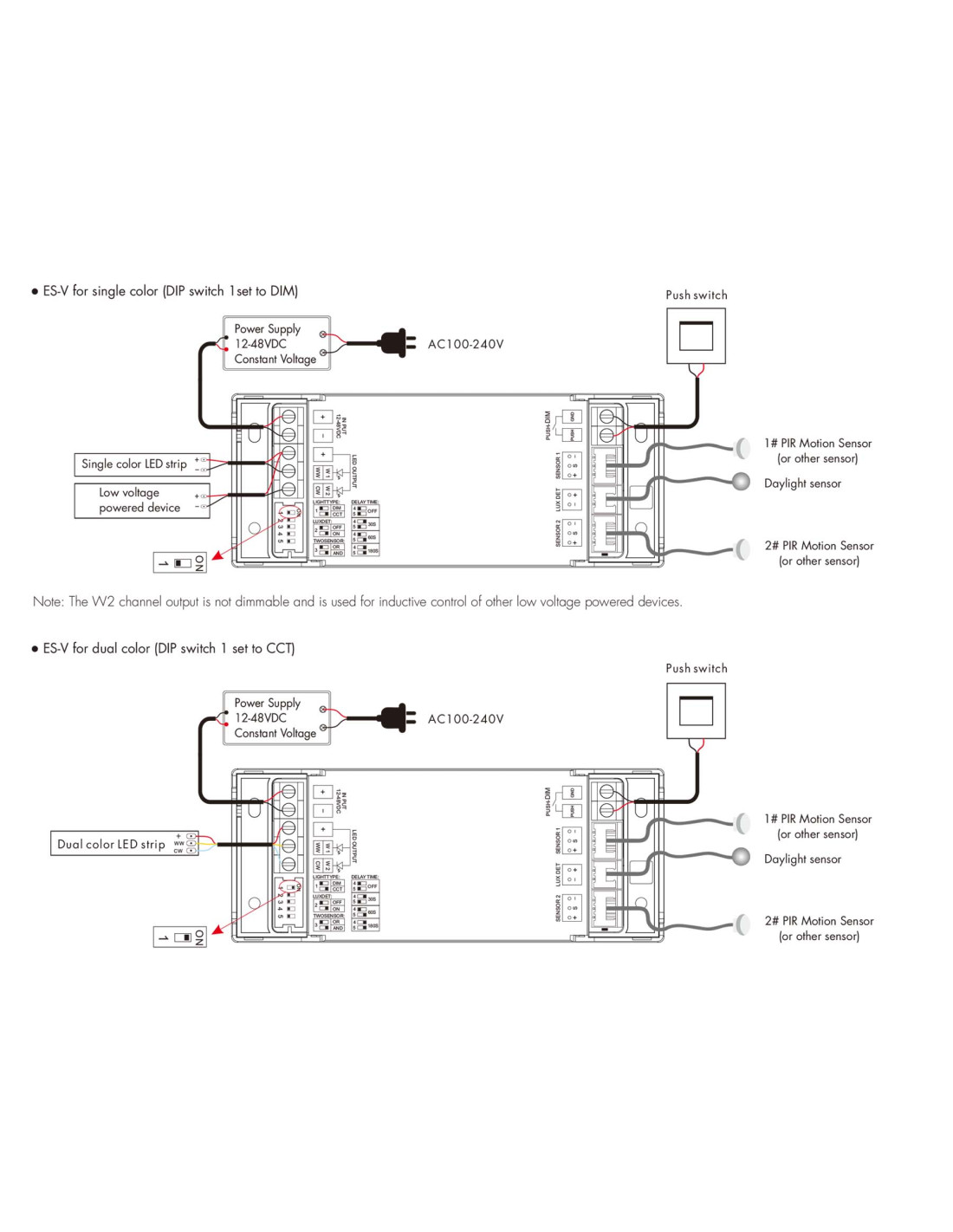
Wiring. Common positive. The terminals take 1.5 mm², stripped 6 mm, as printed on the housing. Power positive and power negative go to the supply. LED+ is the strip positive. W1 is the warm-white negative. W2 is the cool-white negative. A strip that uses a common negative will not run on this controller.
Single colour. Set switch 1 to DIM. Connect the strip between LED+ and W1. W1 dims from 10% to 100%. W2 does not dim. W2 only switches another low-voltage device on and off, at the same voltage and within the current above. Set switch 1 before the strip is connected, and leave it there.
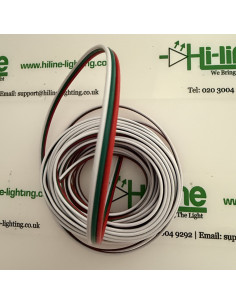
Tunable white. Set switch 1 to CCT. Use a 3-wire strip: LED+, warm to W1, cool to W2. A 2-wire strip, a 4-wire RGBW strip or a 5-wire strip is the wrong type for this mode. A 3-core lead is the matching cable.
Level. The lowest dimmed level is 10%. That is not off. Off is a separate state, from a short press or from the sensors. The fade has 4096 steps at 2000 Hz.
Push switch. This is not in the box. Use a momentary, self-resetting switch, as a dry contact between PUSH and GND. It is not a latching rocker, and it is not a mains switch. Do not put 230 V on these terminals. The sensors cannot set brightness or colour temperature. Only the push switch can. Until a push switch has set a level, a sensor switches the output at the top of the range.
Single colour, on the push. A short press turns the light on or off. A long press of 1-6 seconds raises or lowers the brightness between 10% and 100%, and the direction reverses each time the press is released. A double click jumps between 10% and 100%.
Tunable white, on the push. A short press turns the light on or off. A long press of 1-6 seconds, while the light is on, sets the brightness in the same way. A double click, while the light is on, steps through warm, neutral and cool, and the next long press then sets the colour temperature instead of the brightness. A long press while the light is off also sets the colour temperature. Each new long press reverses the direction.
Sensor sockets. Each socket is a 5 V input. High is on, low is off. The head takes its power from that socket. Do not power a head from the LED supply or from another 12 V source. The 1 m lead drawn on the diagram is only an example. The PIR heads in the box are on 1.2 m leads, and two 5 m extensions are included. Keep those leads away from mains cable.
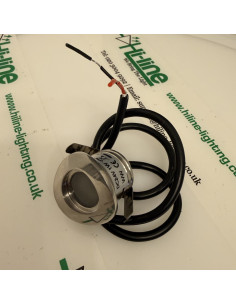
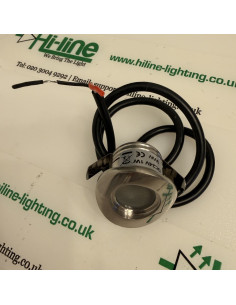
PIR head in the box. Detection is about 3 m, over about 20-40 degrees. The face is about 26 mm, the hole is 20 mm, and the depth is about 16 mm. On a stair, fit one head at the top and one at the bottom.
Daylight. Switch 2 is marked LUX DET. ON makes a PIR switch the light only when the probe sees a low ambient level. OFF ignores daylight. Place the probe where the strip cannot shine on it. If the strip lights the probe, the controller can switch itself off. The probe does not dim the strip, and there is no separate lux figure to set.
Two sensors. Switch 3 is marked OR and AND. OR: the light comes on when either sensor is on. Use OR for a staircase, a corridor, a single door, and for a hand-sweep or touch head. AND: use this only with two door sensors. The light stays on if either door is open, and it goes off only when both doors are closed.
Delay. Switches 4 and 5 add time after a PIR has cleared. Both off: no added delay. Switch 4 to 30S and switch 5 off: 30 seconds. Switch 4 off and switch 5 to 60S: 60 seconds. Both to the long position, 180S: 180 seconds. For a door, a hand-sweep or a touch head, set switches 2, 4 and 5 off. Those heads hold the light themselves. The controller must not add a daylight block or a run-on to them.
Where it is used. A staircase, with a PIR at each end, switch 3 on OR, and a 30, 60 or 180 second run-on. The whole flight comes on together. A corridor or a landing, in the same way. A wardrobe or a cabinet. A bedroom or a living room, where the push switch sets the level and a sensor switches it. Dry rooms only. The body is IP20.
Separate heads, not in this box. A door sensor and a hand-sweep sensor use the same sockets. A narrow-beam head for a long corridor does too. If that head is used later, its beam is about 2.5 m, so a corridor wider than that needs a head on each side. Leave switch 3 on OR, and leave the controller delay at 30, 60 or 180 seconds, because that head itself only holds for about 2 seconds.
Protection and size. Over-heat and over-load protection are built in. If the output drops out, the load or the temperature is past the rating. Ambient -30 to +55 C. Case up to 85 C. Body 115 x 46 x 16 mm, with a fixing hole in each end tab. Weight 0.21 kg. Warranty 5 years.