DMX512 Cable Guide: Correct Wiring, Device Limits, Splitters and Best Installation Practice
DMX512 is one of the most widely used protocols for controlling LED lighting, architectural lighting, stage lighting and intelligent fixtures.
A common question installers ask is what cable should be used for DMX signals and whether cables such as 0.75 mm² cable or Cat5 network cable are suitable.
Understanding the correct cable type and installation practice is important to ensure stable communication and reliable lighting control.
DMX512 Uses Differential Data Communication
DMX512 is based on RS-485 differential communication.
The signal is transmitted using two lines:
DMX Data+ DMX Data−
These two signals must always travel together on the same twisted pair of wires. The twisting helps cancel electrical noise and keeps the signal stable over longer distances.
Because of this, DMX systems are designed to operate with 120Ω impedance twisted pair data cable.
Recommended Cable for DMX Installations
The correct cable for DMX systems is:
120Ω DMX512 cable Twisted pair data cable Shielded cable
This type of cable is designed specifically for DMX or AES/EBU digital signal transmission and ensures reliable operation, particularly in larger installations.
Can 0.75 mm² Cable Be Used for DMX?
This is a common misunderstanding.
Cable size such as 0.75 mm² only describes the conductor thickness, which is relevant for power cables. It does not define the electrical characteristics needed for data transmission.
Most 0.75 mm² cables are:
Power cable Control cable Not twisted pair Not 120Ω impedance
Because of this, standard 0.75 mm² cable is generally not suitable for DMX communication.
Using this type of cable may result in:
Signal reflections Communication instability Data errors
Can Cat5 or Cat6 Cable Be Used for DMX?
Yes, Cat5 or Cat6 network cable can often be used successfully for DMX installations, especially in architectural lighting systems.
Cat cables already contain twisted pairs, which are suitable for differential data communication.
For best performance it is recommended to use:
Shielded Cat5 or Cat6 cable
When using Cat cable for DMX it is very important that:
DMX Data+ and Data− are connected on the same twisted pair The pair is not split across different wires
This ensures proper signal balance and reduces interference.
Maximum Number of Devices on a DMX Line
One very important rule in DMX installations is the maximum number of devices per DMX chain.
A single DMX line should not exceed 32 devices.
Each connected device adds electrical load to the signal line. If too many devices are connected, the signal can become unstable and communication errors may occur.
When an installation requires more than 32 devices, the system must be expanded using DMX signal splitters.
What is a DMX Signal Splitter?
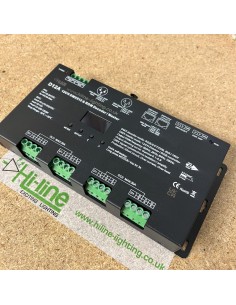
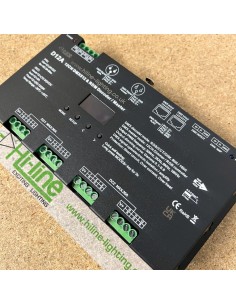
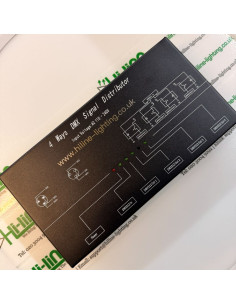
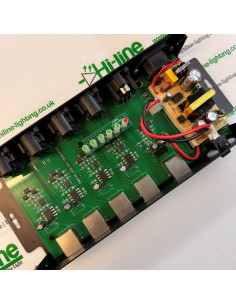
A DMX splitter receives one DMX signal input and distributes it into multiple independent outputs.
Each output becomes its own DMX line and can support up to 32 devices per chain.
DMX splitters are commonly used in installations with:
Large lighting systems Multiple lighting zones Long cable runs Many fixtures or LED controllers
Why DMX Splitters Are Recommended
Even when the system is small, installing a DMX splitter can improve reliability.
For example, if an installation only includes 2 or 3 DMX devices, it will normally operate without a splitter.
However, using a splitter is still recommended in many professional installations, particularly when the system contains valuable or sensitive DMX equipment.
Benefits of using a splitter include:
Electrical isolation between DMX lines Protection for the main DMX controller More stable signal distribution Reduced risk of faults spreading through the system
If a cable fault or device failure occurs on one branch, the splitter helps prevent the issue from affecting the entire installation.
For systems containing expensive DMX lighting equipment, adding a splitter is considered good installation practice.
DMX Terminators
Another important component in DMX systems is the DMX terminator.
A terminator is a small plug containing a 120Ω resistor that is installed at the end of the DMX line.
Its purpose is to stop signal reflections which can cause communication problems.
Best practice is to place a DMX terminator at the last fixture in the DMX chain, especially when cable runs are long.
Best Practice for DMX Wiring
For reliable DMX operation, installers should follow these guidelines:
Use 120Ω shielded DMX cable whenever possible Shielded Cat5 or Cat6 cable can also be used Always connect Data+ and Data− on the same twisted pair Do not exceed 32 devices per DMX chain Use DMX splitters for larger installations Install a DMX terminator at the end of the line Avoid running DMX cables parallel to mains power cables
Following these practices helps ensure stable DMX communication and long-term reliability.
DMX Accessories Available from Hi-Line Lighting
At Hi-Line Lighting we stock a wide range of DMX equipment and accessories including:
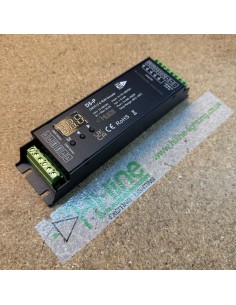
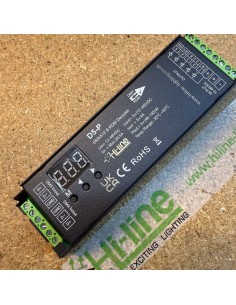
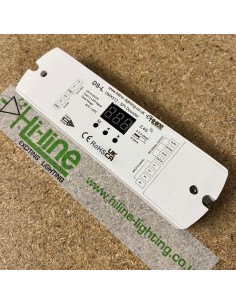
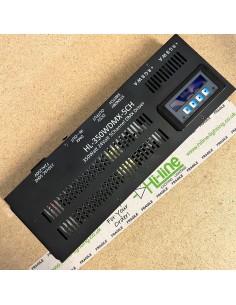
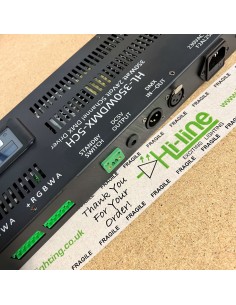
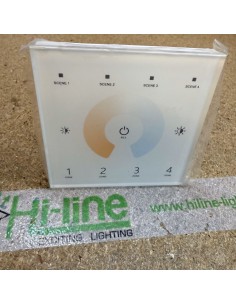
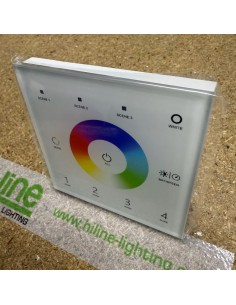
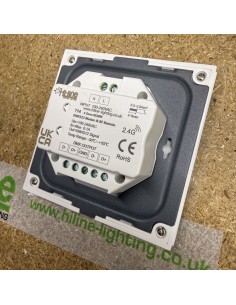
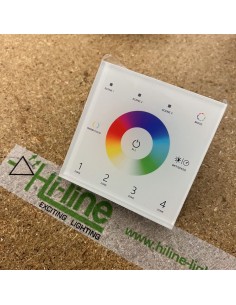
DMX controllers DMX wall panels DMX signal splitters DMX terminators DMX cables and accessories
If you cannot find a specific DMX product or accessory on our website, please contact our team and we will be happy to assist.